

——Course Report on “Introduction to Computer Music”
About the project
This article serves as my final project report, wherein I integrated the knowledge of computer music acquired from the course, the Nyquist language taught by Roger, and my prior understanding of MATLAB. I accomplished a comprehensive analysis of the timbre of clarinet sustained notes, encompassing the entire process from experimentation and data collection to data analysis and machine learning. Additionally, I have refined the built-in clarinet timbre model in Nyquist, drawing upon my personal experiences with the timbral differences in the clarinet’s overtone and low-frequency ranges observed during my clarinet learning journey.

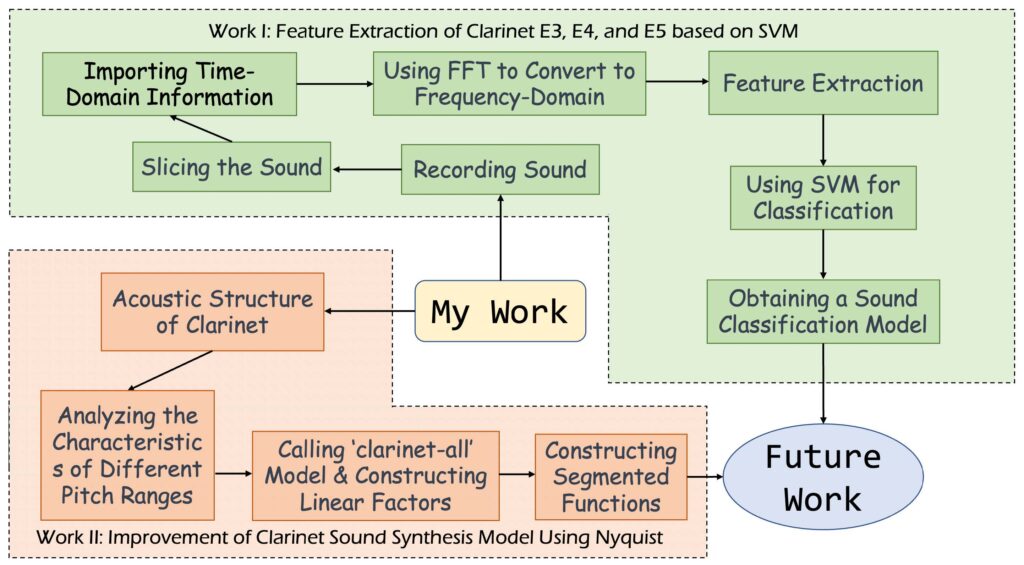
Figure: The Overall Structure of the Research
Summary
This paper begins with a comprehensive review of literature in the field of clarinet sound analysis and synthesis, identifying valuable references from previous research.
In the study of noise components, I collected samples of E3, E4, and E5 notes through self-recordings and performed preprocessing tasks such as slicing and frequency domain transformation. Thirteen representative features were selected for spectral analysis, and feature extraction was performed on the spectral signals. Utilizing the SVM algorithm based on machine learning, the sound quality was first assessed by human hearing and then labeled based on the prominence of noise components, thereby constructing a sound quality classification model. Although the E5 note cannot be accurately classified, the classification accuracy for E3 and E4 test sets reached 90% and 75%, respectively.
In terms of clarinet sound construction, I compared and analyzed the recorded scales to depict the characteristics of each pitch range of the clarinet. Using filter functions, I filtered the clarinet sound model based on the “clarinet-all” function in Nyquist, creating a more realistic and expressive clarinet sound model. Furthermore, the generated E3 and E4 notes were incorporated into the classification model, both of which were classified as high-quality sounds in the SVM evaluation.
In conclusion, I analyzed the issue of the SVM algorithm’s inability to accurately analyze the high-pitched E5 note and proposed a future concept that combines the SVM algorithm with the analysis of timbre in different pitch ranges of the clarinet.
Click or drag to the floating window to download